Hurricane Roof Claims in a Metro That Has Filed More Than Most
Lake Charles took Hurricane Laura as a Category 4 landfall with the eyewall passing almost directly over the city, then Hurricane Delta followed the same track roughly six weeks later while a lot of roofs were still under tarp. Few commercial metros in the country have run that many hurricane roof claims through their system in such a short window, and it changed how we document hurricane damage: full-roof, every time, with the named-storm deductible in mind from the first inspection.
Why Named-Storm Deductibles Change the Documentation
Most commercial property policies here carry a separate, percentage-based deductible for named storms that runs well above the flat-dollar deductible for other wind events. That number is usually calculated against the building's insured value, so on a large plant or hospitality property it can be a substantial figure before the carrier's payment starts. Because of that, thin documentation costs an owner more here than it would on a standard wind claim: if the damage assessment undercounts the affected area, the owner can end up covering costs out of pocket that a fuller report would have placed above the deductible threshold.
We document hurricane damage with that math in mind, capturing the complete affected area rather than only the section that's obviously failed, so the claim reflects the storm's actual footprint on the roof.
How Hurricane Wind Actually Fails a Roof Here
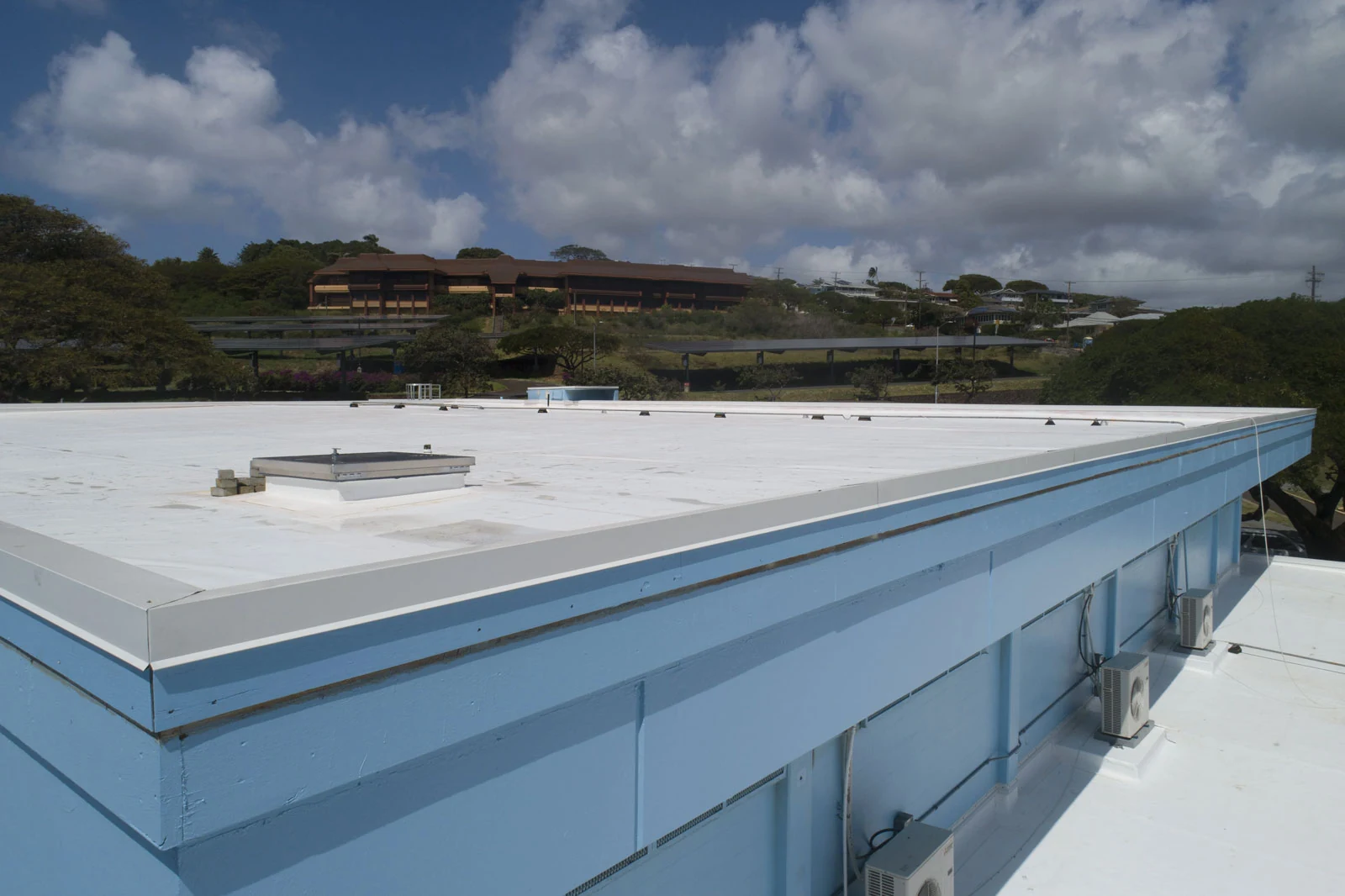
Laura and Delta showed the same failure patterns repeatedly across the parish. Membrane roofs lose their hold at parapet corners and rooftop unit curbs first, where uplift pressure concentrates, then the wind works inward from that starting point. Metal panel roofs, standing seam and R-panel both, tend to fail at clip attachment points or where a seam wasn't fully engaged, and once a panel starts lifting, its neighbors follow in sequence along the same edge. A roof can look intact from the ground with a string of lifted panels running the length of one side.
Wind-driven rain adds a second layer most owners don't expect: water intrusion through undamaged-looking flashing or through fastener backout that never shows as a visible tear. We check insulation moisture content across the roof, not only near obvious openings, because a hurricane claim that misses wet insulation under an intact-looking membrane tends to resurface as a leak claim months later.
Documenting for Petrochemical and Port Properties
The Westlake and Sulphur industrial corridor carries some of the largest single-roof footprints in the region, and a hurricane claim on a plant roof involves coordinating documentation with facility operations, since sections may need to stay weathertight for ongoing processes while other sections are assessed and repaired. Port-adjacent industrial buildings face similar scale issues along with added salt-air exposure that can make it harder to distinguish fresh hurricane damage from ongoing corrosion at fasteners and edge metal. We separate those categories explicitly in our documentation, since a claim that blurs storm damage with pre-existing corrosion is easier for a carrier to challenge.
Documenting for Casino and Hospitality Properties
Several lakefront casino and hospitality roofs took direct hits in both 2020 storms, and those properties carry a different urgency: every day a section stays under tarp is lost operating capacity for a major regional employer. We phase inspection and documentation to support fast temporary dry-in while still building a complete claim file, so the emergency repair and the insurance claim move on parallel tracks instead of one waiting on the other.
What This Doesn't Replace
None of this substitutes for the owner's own conversation with their carrier and adjuster. We're your roofing contractor, not a public adjuster: we document what's on the roof, measure it, photograph it, and put a clear repair scope in writing. Deciding coverage, applying the deductible, and approving payment stays with the insurance company.
For the parish's non-hurricane wind events, see our wind and storm damage claims page, and for the general claims process this fits into, see commercial roof insurance claim assistance. Our insurance documentation support service covers the day-to-day mechanics of what we photograph and measure.
- Full-roof documentation scoped to named-storm deductible math, beyond only the visible damage
- Insulation moisture checks across the roof field, not only near obvious openings
- Clear separation of storm damage from salt-air corrosion or prior wear
- Section-by-section reporting for large plant and port industrial roofs
- Phased documentation for casino and hospitality properties under operational pressure
- On-roof meeting with the assigned adjuster once a site visit is scheduled
Hurricane Roof Claim Questions
Is the deductible different for hurricane damage than other storm damage?
Usually, yes. Most commercial policies in this parish carry a separate, percentage-based named-storm deductible that's higher than the flat-dollar deductible for other wind events. We factor that into how thoroughly we document damage, since a fuller report can be the difference between staying above or below that threshold.
How soon after a hurricane should the roof be inspected?
As soon as it's safe to access. Wind and wind-driven rain damage that isn't leaking yet can still be a failure waiting on the next rain, and documentation gets harder once temporary tarping or a second weather event changes what's visible.
Will you find hurricane damage that isn't visible from the ground?
Often, yes. Lifted seams, backed-out fasteners, and corner uplift on membrane roofs frequently don't show from street level, which is why we walk the full roof rather than only the reported damage area.
Can you tell hurricane damage apart from salt-air corrosion?
Yes, and we document that distinction explicitly. Coastal and port-adjacent roofs often show both, and a claim that doesn't separate them clearly is easier for a carrier to push back on.
Do you help with claims on plant or casino-scale roofs?
Yes. Large industrial and hospitality roofs get section-by-section documentation that matches how carriers typically break out bigger commercial claims, and we coordinate timing with facility operations where needed.